
Table of contents
Why pharma quality teams that invest in site and inspection intelligence often leave their most consequential risk blind spot unaddressed.
The most forward-thinking quality teams in pharma have made real progress on supply chain risk. They’re monitoring inspection trends. They’re benchmarking site risk against global enforcement data. They’re replacing reactive fire drills with structured, data-driven oversight.
And yet many of those same teams are still getting caught off guard. Not because their tools are failing them, but because there’s a gap in the intelligence picture that site and inspection data alone can’t fill.
The inspections you're preparing for and the sites you're monitoring are downstream consequences of something happening upstream: regulatory change. New guidance documents. Evolving enforcement priorities. Shifting agency interpretations of GMP requirements. Redica monitors thousands of potential signals daily across 422 agencies, curating the ones that matter into a normalized, continuously updated database that now tracks more than 9,000 published regulatory documents annually. If your team isn't tracking those signals in real time, you're preparing for the inspection of last year, not next year.
That’s the gap the Redica Regulatory Intelligence Cloud closes.

Inspection Risk Doesn’t Start at the Site. It Starts at the Agency.
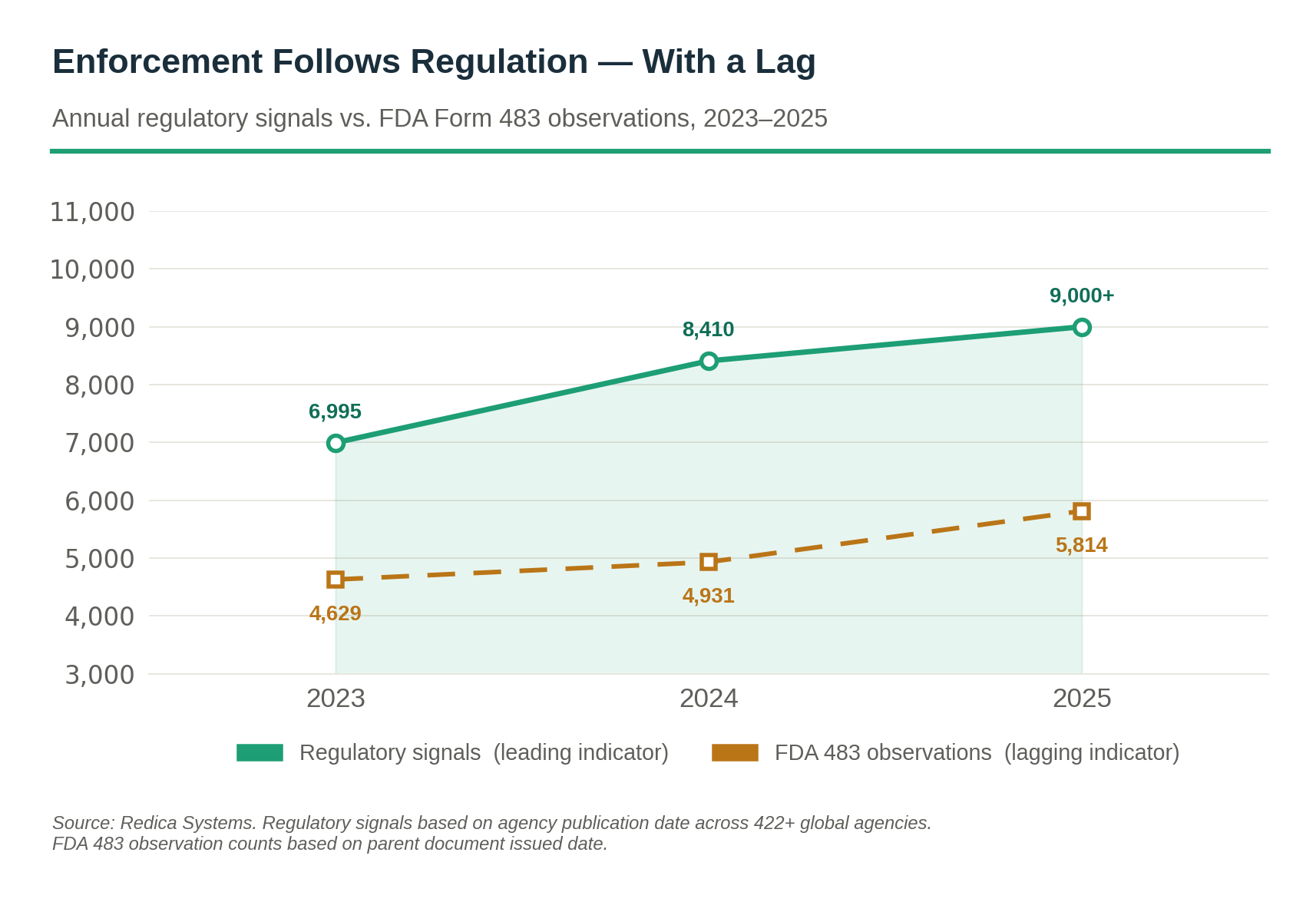
Every inspection trend you monitor is a lagging indicator. Form 483 observations, warning letters, enforcement patterns: these are the outputs of agency priorities that were shaped months or years earlier by regulatory changes your team may or may not have caught. Redica's data tells the story clearly: between 2023 and 2025, FDA Form 483 observations grew 26%, from 4,629 to 5,814 annually, rising in lockstep with a regulatory signal landscape that crossed 9,000 published documents in the same period. The enforcement follows the regulation, and the gap between those two curves is exactly where unprepared teams get hurt.
When FDA updates a guidance on contamination control strategy, or EMA finalizes revisions to Annex 1, or PMDA signals a shift in how it’s interpreting sterility assurance requirements, inspection focus shifts accordingly. Teams that catch those signals early can update SOPs, retrain staff, and address gaps before an investigator arrives. Teams that don’t catch them often find out the hard way.
The Redica Regulatory Intelligence Cloud gives you the upstream signal. It surfaces regulatory changes, draft guidance, and enforcement priority shifts in real time, contextualized against the inspection and enforcement data you’re already using.
The Manual Monitoring Problem Is Bigger Than You Think
Most quality teams today are cobbling together regulatory change management from a combination of email alerts, periodic website checks, internal distribution lists, and spreadsheet trackers. Consider what they're up against: Redica monitors thousands of potential signals every day across 422 agencies globally (FDA, EMA, MHRA, PMDA, Health Canada, TGA, Swissmedic, MFDS, and hundreds more) and curates only the material regulatory changes that actually belong in a quality team's workflow. In 2025 alone, that database crossed more than 9,000 published regulatory documents. The complexity extends even into markets that are often underestimated: see how Redica tracks regulatory change across Russia's fragmented landscape for a sense of the depth of coverage required. That curation process is itself a capability most teams can't replicate manually. And it has three specific failure modes when they try.

- Volume. The number of regulatory signals across FDA, EMA, MHRA, HC, PMDA, MFDS, Swissmedic, and other agencies is too high for any team to manually track with consistency. Things get missed.
- Context. A raw regulatory update tells you what changed. It rarely tells you what it means for your specific products, sites, or processes, or how it connects to what agencies are actually citing in inspections right now.
- Speed. By the time a change is summarized, routed, discussed, and acted on through manual processes, the window for getting ahead of it has often closed.
Regulatory Intelligence replaces that process with automated, continuously updated coverage and AI-enriched summaries surfaced directly in the signal feed. Your team sees what changed, why it matters, and what to do, without leaving the platform.
Connected Intelligence Means the Whole Picture, Not Half of It
Regulatory Intelligence isn’t designed to sit in isolation. The real power comes from connecting it with site risk and inspection data, giving you something no standalone monitoring tool can offer: a closed loop between what’s changing at the regulatory level, how agencies are enforcing it in practice, and how your specific sites and suppliers are exposed.
- See a new guidance draft on contamination control? Immediately understand which of your sites have recent findings in related areas. Quality Unit citations are the single most common observation category in Redica’s 483 database, appearing in over 16,000 observations.
- Tracking an enforcement trend in a therapeutic area? Correlate it against the regulatory signals driving that trend.
- Preparing for an inspection at a critical supplier? Know not just their inspection history, but the current regulatory environment shaping what investigators are looking for.
This is the Redica Regulatory Intelligence Cloud in practice: not another feed to monitor, but a layer of context that makes your existing quality intelligence sharper.
Built for QA and RA to Actually Work Together
One of the more persistent friction points in life sciences organizations is the handoff between regulatory affairs and quality assurance. RA catches a change. QA needs to act on it. But the tools, workflows, and timelines are often misaligned, and the result is delays, rework, and risk exposure that nobody intended.
Regulatory Intelligence addresses this directly. Built-in impact assessment workflows and triage routing help QA and RA teams evaluate changes consistently and get to action faster. Smart Cards surface AI summaries in the signal feed so teams can assess relevance without clicking through dozens of documents. And because it lives within the same connected platform as site and inspection intelligence, there’s no disconnect between the signal and the action.
The result is a shared view of risk that spans the regulatory-to-quality lifecycle, not two separate teams working from two separate sets of information.
What Quality Leaders Are Telling Us
The pattern we hear consistently from quality leaders who have added the Redica Regulatory Intelligence Cloud to their program is the same: they had site risk and inspection readiness covered, but they kept getting caught off guard by regulatory changes that shifted enforcement priorities before their team had time to respond.
Once Regulatory Intelligence is in place, the question shifts from “why didn’t we know about that?” to “we saw that coming three months ago.” That is a fundamentally different position to be in when you’re managing a global quality system.
Ready to Close the Loop?
Learn how the Redica Regulatory Intelligence Cloud for Quality Teams connects regulatory, inspection, and site intelligence into one complete, proactive compliance program.