Table of contents
Japan's regulatory system is widely recognized as one of the most rigorous in the world, setting a global benchmark for quality, safety, and risk management. For life sciences companies operating in this market, that reputation is both reassuring and demanding.
The challenge is not whether Japan's framework is credible. It is. The challenge is that this framework is also one of the most structurally complex to monitor, interpret, and act on, particularly for regulatory intelligence teams responsible for tracking changes across multiple markets simultaneously.
This post breaks down the key sources of complexity in Japan's regulatory environment and explains what a modern regulatory intelligence approach needs to do to address them effectively.
Japan's Multi-Agency Structure: More Than One Source of Truth
Regulatory oversight in Japan is distributed across three primary authorities, each with a distinct role in the system.
- The Ministry of Health, Labour and Welfare (MHLW) serves as the primary regulatory authority. It sets policy, issues guidance, classifies products, and makes final approval decisions under the Pharmaceuticals and Medical Devices (PMD) Act.
- The Pharmaceuticals and Medical Devices Agency (PMDA) functions as the technical and scientific arm, conducting product reviews, performing inspections, and managing post-marketing safety activities.
- The Ministry of Agriculture, Forestry and Fisheries (MAFF) plays a role in certain cases, particularly for animal health products, adding an additional layer to an already complex system.
While each authority has a clearly defined mandate, their combined involvement creates a fundamentally multi-layered environment. Regulatory events do not originate from a single source, and monitoring any one agency in isolation is insufficient for organizations that need a complete view of the landscape.
The PMD Act and Its Distributed Documentation
Japan regulates pharmaceuticals, medical devices, in vitro diagnostics, and certain animal health products under the Pharmaceuticals and Medical Devices Act. The PMD Act governs approval pathways, manufacturing and marketing authorizations, quality standards such as GMP and QMS, pharmacovigilance requirements, clinical data expectations, and labeling regulations.
What makes this difficult in practice is that these requirements are not consolidated into a single authoritative source. They are distributed across a network of acts, ordinances, notifications, administrative guidance, and Q&A documents that must be read in relation to one another.
For regulatory intelligence teams managing Japan alongside other jurisdictions, this distributed documentation model significantly increases the cost of staying current.
A Framework in Continuous Motion: Tracking Regulatory Updates
Japan's regulatory framework evolves continuously. Changes arrive through amendments to the Act itself, new or revised ordinances and enforcement regulations, MHLW and PMDA notifications, updated guidelines, and Q&A publications.
These updates rarely stand alone. A single change may modify prior regulations, clarify existing guidance, or introduce new interpretations that can only be understood in the context of multiple preceding documents. The result is a chain of dependencies rather than a linear structure, where understanding one update often requires tracing its relationship to several others.
Example: The QMS Ordinance
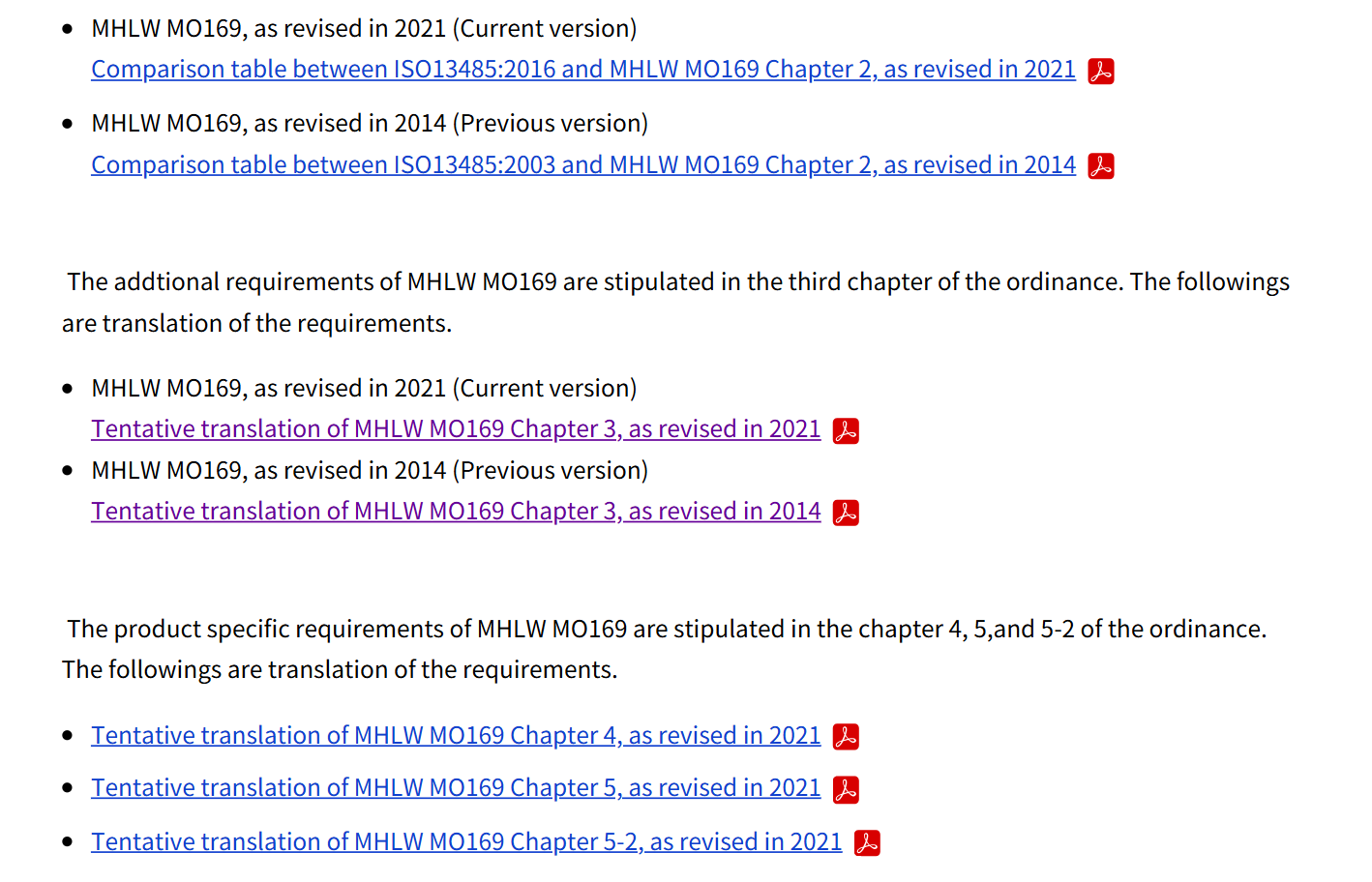
The evolution of the QMS Ordinance (MHLW Ministerial Ordinance No. 169 of 2004) illustrates this challenge clearly. While the PMDA provides a high-level summary of its updates, spanning revisions in 2014, 2017, and 2021, it does not publish a single consolidated version of the regulation.
Stakeholders must interpret multiple amendments and supporting documents together to understand current requirements. This fragmented structure makes it difficult to determine exactly what has changed and what actions are required.
PMDA QMS Ordinance Summary:
The Backdating Problem: When Official Dates Do Not Reflect Availability
Beyond structural complexity, regulatory intelligence teams in Japan face a timing challenge that is easy to overlook but carries meaningful operational risk: the backdating of regulatory publications.
In some cases, documents are uploaded to the PMDA or MHLW websites days after their stated publication date. This creates a disconnect between when information becomes publicly available and when it is officially dated.
A guidance document titled 'Considerations for Clinical Trials with a Small Number of Cases (Early Consideration)' became publicly available on March 31, 2026, while the date stated in the document is March 19, 2026, a gap of twelve days.
For teams managing compliance timelines, this discrepancy introduces real risk:
- Apparent delays in regulatory response when teams are measured against official publication dates
- Increased manual validation effort to reconcile stated dates with actual availability
- Challenges in meeting internal SLAs tied to publication events
- Potential audit exposure when the compliance record does not reflect the true timeline
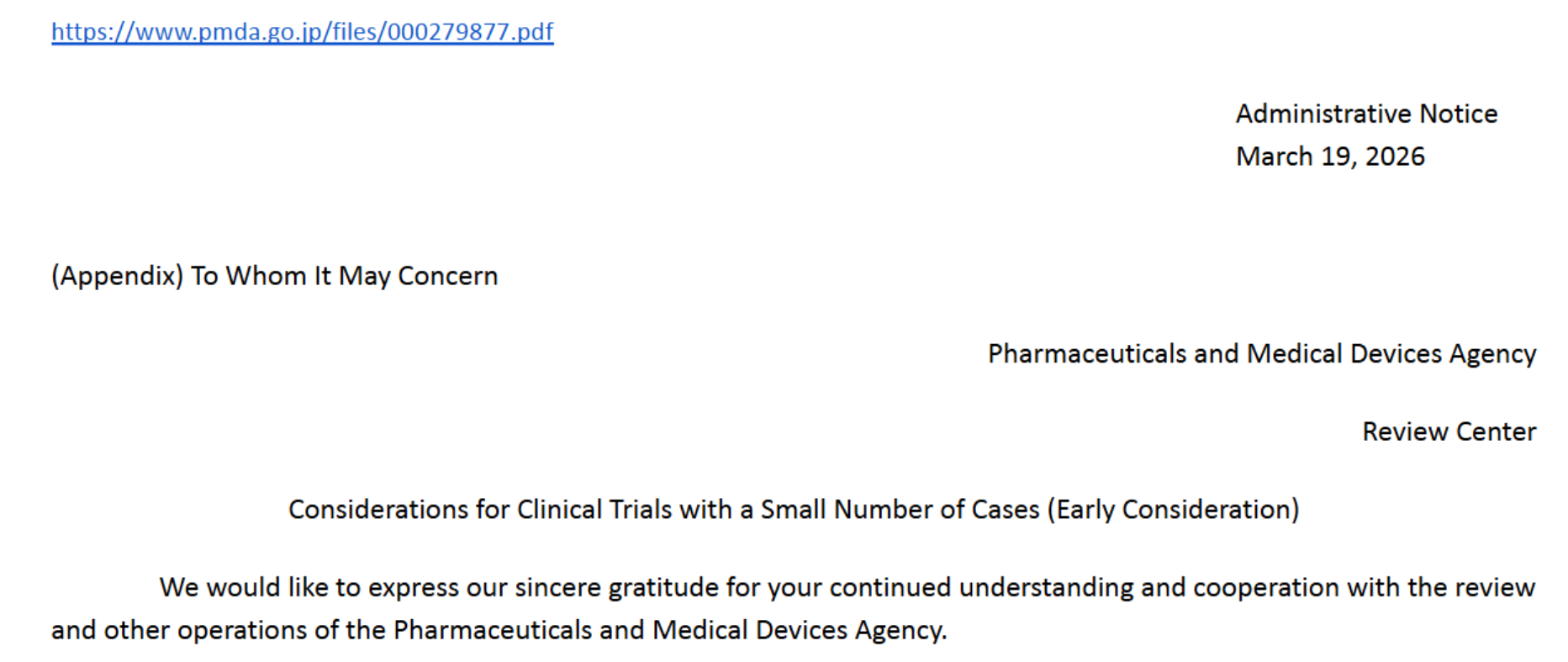
Addressing this requires monitoring systems that capture first-seen timestamps alongside official publication dates, providing a more accurate record of when information became actionable and supporting stronger audit defensibility.
Duplication Across Agencies: Separating Signal from Noise
A related challenge is the duplication of regulatory content across MHLW and PMDA. Both agencies sometimes publish the same document, occasionally on the same day, and other times with a delay between releases. The core content is typically identical, but the publications may vary in format, structure, or presentation.
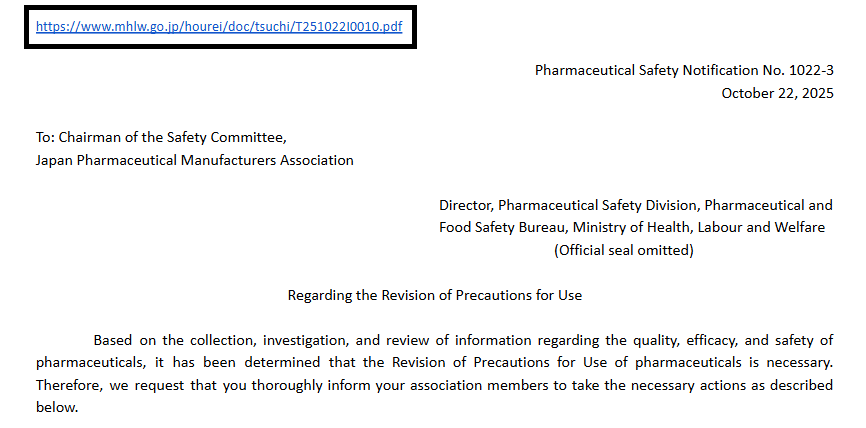
A clear example is the 'Revision of Precautions for Use' published October 22, 2025, which appears on both agency websites. MHLW serves as the issuing authority; PMDA typically republishes for operational or review purposes.
MHLW version:
PMDA version:

Without this context, the same update may be captured multiple times and treated as separate regulatory events. For regulatory intelligence teams, this duplication creates noise in the impact assessment process. Teams spend time in triage determining which publication is actionable, rather than focusing on what the change requires.
What Effective Regulatory Intelligence Looks Like in Japan
Navigating Japan's regulatory environment at scale requires more than basic monitoring. It requires a structured, contextual approach that connects documents, preserves history, and eliminates noise before it reaches analysts.
Specifically, an effective regulatory intelligence solution for Japan needs to:
- Link new publications to the underlying acts, ordinances, and guidelines they amend or reference, creating a traceable lifecycle for each document
- Maintain version histories so teams can understand how requirements have evolved over time, not just what the most recent update says
- Map relationships between documents so that the downstream implications of a change are visible, not just the change itself
- Capture first-seen timestamps alongside official publication dates to provide an accurate record of when information became available
- Identify and consolidate duplicate publications across MHLW and PMDA so that teams receive one actionable signal rather than multiple redundant entries
Redica Systems' Regulatory Intelligence platform is built to address these requirements directly. By transforming fragmented regulatory data into a structured, traceable system, Redica enables teams to move from reactive monitoring to proactive decision-making, with reduced manual effort, clearer impact assessment, and faster, more confident compliance actions.
The Bottom Line
Japan's regulatory framework is both influential and inherently complex. Its multi-agency structure, distributed documentation, continuous updates, and practical inconsistencies such as backdating and duplication create significant challenges for organizations that need to stay current and respond effectively.
For regulatory intelligence process managers and their teams, the path forward is not more monitoring. It is smarter monitoring, built on structure, context, and traceability.
Organizations that invest in this approach are better positioned to reduce compliance risk, improve team efficiency, and act with confidence in one of the world's most demanding regulatory environments.

Aditi Singhai is a Data Solutions Manager at Redica Systems with 10+ years of experience in regulatory intelligence and operations quality, leading high-impact initiatives across the life sciences industry. She specializes in enhancing data quality and driving measurable improvements in process efficiency.
.jpg)
Khushboo Agrawal is a Data Solution Coordinator in the RegIntel team at Redica Systems, where she focuses on collecting and integrating global regulatory data into the platform. With over nine years of experience in the pharmaceutical industry, she has a background in bioanalytical quality assurance and regulatory leadership at IMCD.
.png)
Tashil Sharma is a Data Solutions Analyst at Redica Systems with 8+ years of experience in regulatory intelligence, data-driven problem solving, and technology solutions for the life sciences industry. Skilled at bridging business needs with analytical and operational excellence, with a strong focus on compliance, quality, and innovation. Passionate about leveraging data and technology to drive smarter decision-making, improve processes, and deliver meaningful impact in highly regulated environments.