
Table of contents
Navigating Russia’s Fragmented Regulatory Landscape
For regulatory intelligence teams supporting pharmaceuticals, biologics, medical devices, and animal health, Russia represents one of the most structurally complex regulatory environments globally. The challenge is not simply the volume of regulations or their technical depth, but the way regulatory information is published, distributed, amended, and contextualized across multiple authorities and platforms.
In recent years, Russia has revised its regulatory governance and publication practices. While these changes were intended to improve oversight and modernization, they have introduced additional intelligence hurdles for companies attempting to build reliable regulatory libraries and maintain continuous compliance visibility. Redica’s platform helps organizations navigate this evolving regulatory landscape by centralizing authoritative Russian ministerial legislation, reducing intelligence gaps, and restoring continuous compliance visibility despite the shifting governance and publication practices.
1. From Centralized Publication to Fragmented Regulatory Pathways
At the core of Russia’s regulatory system is pravo.gov.ru, the singular official legal publication portal. Federal laws, government resolutions, presidential decrees, and many ministerial acts are first published on Pravo, and publication on this platform establishes formal legal validity.
However, Pravo is no longer where regulatory understanding ends. Increasingly, regulations relevant to healthcare products are republished or supplemented on secondary platforms, including but not limited to:
- The Ministry of Health (AKA Minzdrav)
- The Federal Service for Health Surveillance (AKA Roszdravnadzor)
- The Federal Service for Veterinary and Phytosanitary Supervision (AKA Rosselkhoznadzor)
- Other sector-specific guidance pages and repositories
This shift has created a two-stage regulatory visibility model:
- Legal enactment on Pravo
- Operational interpretation through regulator republishing
While theoretically sound, this model introduces a critical intelligence gap: regulations may be enforceable long before their scope, applicability, and enforcement expectations are fully understood.
A clear example of this fragmentation can be seen in a regulatory document first published on the official legal portal on February 1, 2021.
- While the document became legally effective upon publication, it appeared on the Roszdravnadzor website only on December 24, 2025—nearly four years later.
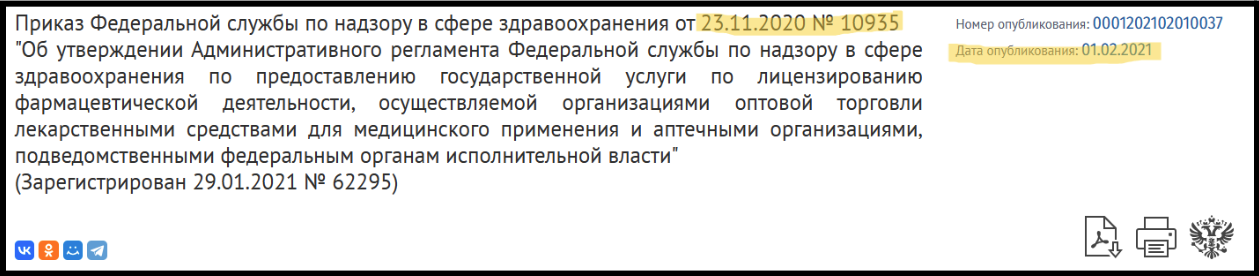

- The Pravo publication contains dense legal text with no sector context, whereas the Roszdravnadzor version placed the same regulation within a drugs-specific regulatory framework, offering practical relevance for industry stakeholders.
Pravo Provides Legal Text but No Regulatory Context
The Pravo legal database:
- Lacks industry or product categorization
- Publishes amendments as standalone acts
- Provides no consolidated versions or applicability guidance
For regulated industries, detection without interpretation is insufficient.
Missing Parent–Child Document Relationships
Many resolutions and decrees:
- Fail to explicitly name the parent regulation
- Amend annexes without clear linkage
- Use vague amendment language
This breaks automated traceability and historical lineage. A great example of this can be seen through the Resolution of the Government of the Russian Federation, No. 853, "... Repeal of Certain Acts and Certain Provisions of Certain Acts of the Government of the Russian Federation"

This formatting does not clearly enumerate parent documents upfront, meaning that manual analysis is required to determine:
- That it repeals 6 different Orders/Resolutions (Resolution No. 771, Resolution No. 441, Decree No. 1001 (Clause 4), Decree No. 882 (Clause 128), Decree No. 1054 (Clause 28), and Resolution No. 1515).
- Which annexes or procedures are modified.
Russian-Only Discovery Makes English Search Impossible
All official Russian regulatory systems:
- Operate exclusively in Russian
- Do not index English titles or keywords
- Recognize only Russian-language legal text
English-based discovery fails entirely, leading to core regulatory instruments—such as Government Resolution No. 1684 governing medical devices or Government Resolution No. 10493 covering human medicinal products— to be overlooked if not explicitly using the Russian title.
50,000+ Documents With No Built-In Scope Definition
Pravo aggregates publications from over 3,000 federal and regional bodies, resulting in:
- Massive document volume
- No indication of national vs regional applicability
- No industry relevance filtering
Without regional expertise, teams are oftentimes left with thousands of documents and no clear scope.
Overlapping Authorities and Slightly Different Phrasing
Multiple Russian Ministries publish on identical topics as well, using:
- Different numbering systems
- Slightly different language
- Overlapping jurisdictional mandates
This obscures familial relationships between documents, making document lifecycles and timeline all the more complex.
National and Regional Regulations Are Mixed Together
Lastly, Pravo’s list-view does not identify specific implementation categories, such as:
- Federal obligations
- Regional or local requirements
This lack of differentiation leads to over-scoping or missed national obligations.
How Does Redica Navigate These Challenges?
Redica addresses the complexities of the Russian regulatory publishing system through a comprehensive, intelligence-driven approach that focuses on accuracy, completeness, and reliability.
We continuously monitor both Pravo and Ministry-level sources, using Pravo as a primary source of legislative publication and the other Russian ministry portals to further enrich intelligence. This enables early detection of regulatory changes, ongoing updates as interpretations evolve, and eliminates reliance on any single source.
Redica operates with a language-first approach, leveraging native Russian legal terminology to ensure complete discovery and accurate classification, while English titles are added only as descriptive metadata, as compared to relying on translated titles for document detection.
To turn fragmented regulatory volume into actionable insight, Redica defines scope before ingestion—filtering for nationally applicable regulations, excluding regional acts unless relevant, and prioritizing documents by regulatory impact.
We apply sector-aware analysis to translate dense legal text into product-relevant intelligence and manually reconstruct regulatory lineage when references are unclear, preserving version history, audit readiness, and accurate impact assessments.
Redica also reconciles documents across authorities to identify duplicates, sequences, and hierarchical relationships, while clearly distinguishing federal regulations from regional acts to ensure compliance libraries reflect true national requirements.
Why Redica’s Regulatory Intelligence Works for Russia
In summary, Russia’s regulatory complexity cannot be solved by more automation or more documents. Rather, it requires regulatory intelligence that defines scope, reconstructs context, and translates legal change into operational clarity.
Redica’s paired problem–solution approach transforms Russia from a fragmented regulatory environment into a manageable, defensible compliance landscape for life sciences organizations.
Redica delivers the clarity regulatory intelligence teams need to operate confidently in Russia’s complex landscape. To see how Redica transforms fragmented Russian regulations into actionable, product-specific intelligence, request a demo today.

Aditi Singhai is a Data Solutions Manager at Redica Systems with 10+ years of experience in regulatory intelligence and operations quality, leading high-impact initiatives across the life sciences industry. She specializes in enhancing data quality and driving measurable improvements in process efficiency.

Barry Price is a Regulatory & Quality professional at Redica Systems with 6+ years of experience in GxP compliance and regulatory intelligence across biopharma and medical device sectors, specializing in GMP and RA-CMC with a proven record of driving operational excellence and customer value through enterprise-wide programs and cross-functional projects.
.jpg)
Khushboo Agrawal is a Data Solution Coordinator in the RegIntel team at Redica Systems, where she focuses on collecting and integrating global regulatory data into the platform. With over nine years of experience in the pharmaceutical industry, she has a background in bioanalytical quality assurance and regulatory leadership at IMCD.