
Table of contents
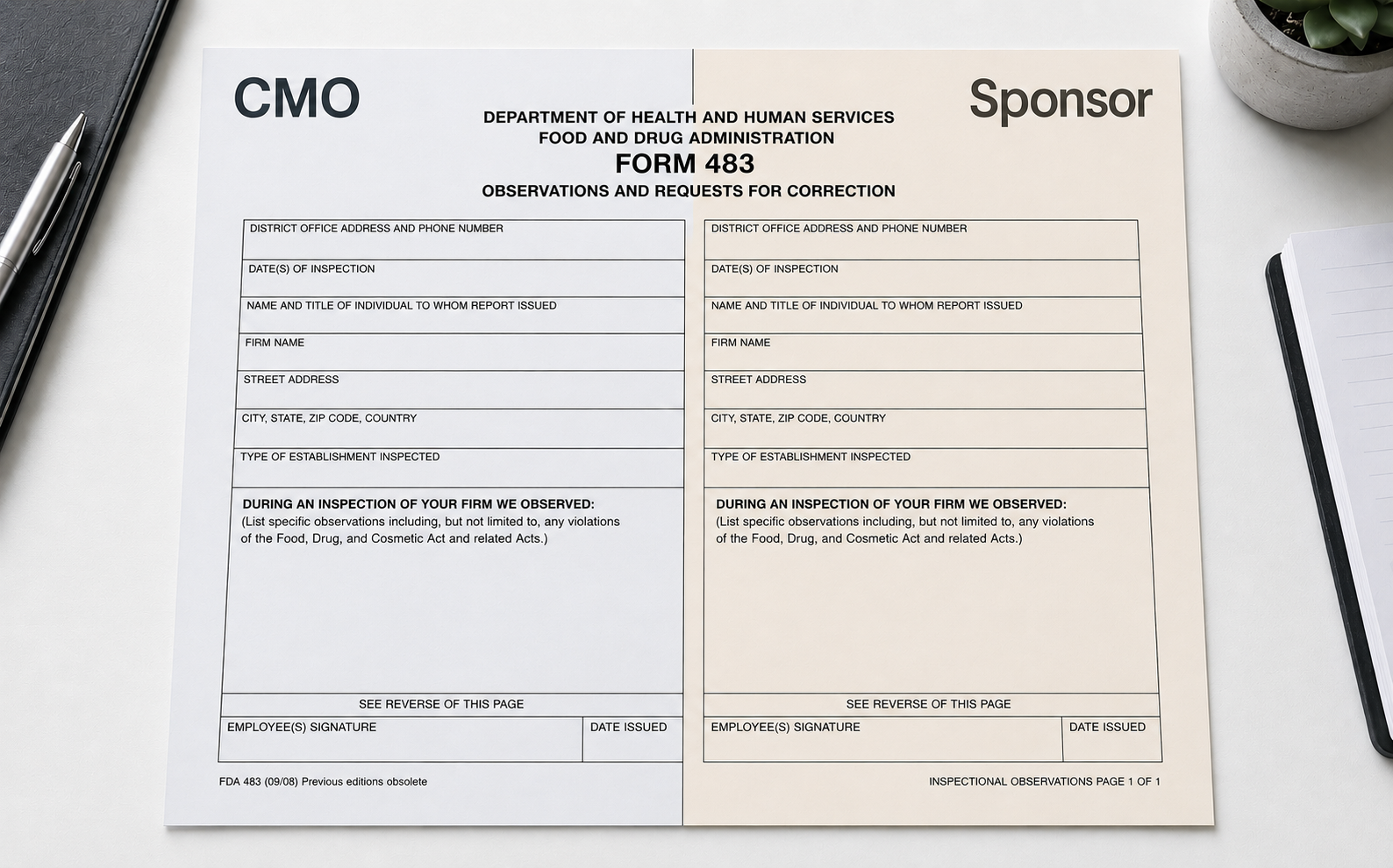
When a CMO receives a Form 483, the observation is issued to the facility, and the quality team drafts the response. But experienced quality leaders on both sides know the picture is more complicated, and sponsors who don't understand their role in it are carrying risk they can't see.
Redica Systems' analysis of 168 innovator CMO sites found that 483 rates at these facilities are higher than at non-CMO sites, but how many of those observations are due to decisions made on the sponsor side? Quality leaders at Thermo Fisher/Patheon, Fujifilm Diosynth, Sentrx, and Boehringer Ingelheim have been direct about this dynamic, and the conclusions are sometimes uncomfortable.
How Sponsor Decisions Generate CMO Form 483 Observations
The mechanisms are more common than sponsors want to acknowledge. Consider a regulatory filing that doesn't accurately reflect the process as executed at the CMO, often because of timeline pressure from the sponsor side. Or a control strategy with gaps the sponsor accepts as tolerable risk, which become observable during manufacturing. None of these will be labeled as “sponsor-caused”. Even when CMO staff flag concerns and are overruled, in a 483 those kinds of issues show up as the CMO's problem.
The clearest and most preventable example is a filing that doesn't match the batch records. The observation is predictable, the cause is identifiable, and the fix is squarely within the sponsor's control. Yet it keeps happening because timeline pressure on the filing side doesn't register as a quality decision at the time it's made. Ensuring the final filing accurately reflects what the CMO is executing is a baseline sponsor obligation.
The Quality Unit Independence Trap: An FDA Inspection Red Flag
A subtler accountability risk arises when sponsors over-influence how deviations are written up, pushing toward root cause conclusions or away from others. If two similar deviations at the same facility result in different findings because different sponsors shaped the investigations, an experienced FDA or MHRA inspector is going to notice. The inference drawn is that the CMO's quality unit isn't exercising independent professional judgment, and that affects how the entire quality system is assessed.
Both FDA and MHRA have specifically flagged quality unit independence. The appropriate model is one where sponsors contribute product knowledge to a deviation investigation, context the CMO may genuinely lack, while the CMO owns the write-up, the root cause conclusion, and the corrective action. Ask whether the investigation would reach the same conclusion if a different sponsor were involved. If the answer is no, independence is likely compromised.
When this model is executed well, the results are visible to regulators. A sponsor engaged appropriately through deviations from Phase 1 to commercial launch, present for product-specific questions but not driving conclusions, represents the kind of relationship FDA has recognized as among the strongest it has seen in a PAI setting. Getting the accountability model right is both a compliance matter and a competitive one.
When a Form 483 Lands: What Sponsors Get Wrong in the Response Window
The 15-business-day response window starts immediately, and every available SME at the CMO is focused on drafting a response that will define the agency's view of quality system credibility. Simultaneously, the CMO must triage sponsor impact, issue notifications, and field client calls.
Sponsors who escalate in the first 48 hours, demand immediate answers, or interpret measured communication as evasion are creating friction at the exact moment the CMO needs to focus. The relationships that navigate 483s most effectively are those where trust was established well before the observation was issued, and where a commitment to a full briefing by a defined date is accepted without alarm.
The distinction between a PAI and a routine inspection also shapes when sponsor involvement is appropriate. When a 483 follows a pre-approval inspection, sponsor participation in the response is expected, since the program is directly on the line and product knowledge is material to the response. For a routine inspection where observations don't touch a specific product or line, sponsors need a clear impact assessment and open communication rather than a seat at the drafting table. It's also worth noting that 483 impact rarely stops at the direct PAI sponsor. Any sponsor with filings in progress at the same facility may be affected by the same observations, and identifying that group requires the CMO to know each sponsor's filing calendar, which in turn requires sponsors to share it.
FDA Inspection Readiness Starts at Program Kickoff, Not PAI
Sponsors who most successfully navigate 483s all had the hard conversations early, documented the outcomes, and built governance structures before problems emerged. By the time a CMO is heading into PPQ or PAI, the decisions that will determine inspection outcomes were made 12 to 18 months earlier, and the conversations that should have shaped those decisions were often never had.
Risk appetite must be explicit and documented at program initiation. For a novel drug with nothing on the market, some tolerance for process gaps is understandable, but the standards are much higher for a biosimilar approaching commercial launch. Both parties need to understand which situation they're in. Beyond risk tolerance, you also have to consider the governance questions. When the CMO's quality team flags a concern and the sponsor disagrees, what happens? Who has the authority to accept a known gap? What does that acceptance look like on paper?
These conversations only become more difficult the longer they're delayed. Soon the stakes are high, the timeline is compressed, and the teams are under competing pressures. Building shared accountability structures at kickoff, rather than cobbling them together during 483 responses, is one of the best ways a sponsor can preserve its CMO relationships.
The full data picture, covering 168 innovator CMO sites from 2022 to 2025, and a detailed framework for building accountability structures that hold up under inspection pressure are covered in our white paper: The New Rules of CMO-Sponsor Collaboration: Inspection Trends, Shared Risk, and the Path to Predictive Quality.