Table of contents
GMP Annex 1 Is Effective. Now Watch How Inspectors Are Actually Using It.
The revised GMP Annex 1 for the Manufacture of Sterile Medicinal Products took effect in August 2023 (with the exception of chapter 8.123, effective in August 2024). Most quality teams spent the preceding year building gap assessments, updating contamination control strategies, and briefing leadership on what the 59-page rewrite would mean for their sterile manufacturing operations. That work was necessary and largely done.
But here's the question that should be keeping compliance leaders up now: How many jurisdictions have adopted GMP Annex 1, and how are regulators actually enforcing it in inspections?
Those are different questions than "what does Annex 1 say," and increasingly, they are the more important ones.
GMP Annex 1 Is a Global Standard, Not Just a European One
In 1989, the EU adopted its own GMP Guide, equivalent to the PIC/S GMP Guide. Since then, the two have been developed in parallel. When one changes, the other follows. GMP Annex 1 was synchronized across EU and PIC/S simultaneously, making it a global standard for sterile manufacturing from day one.
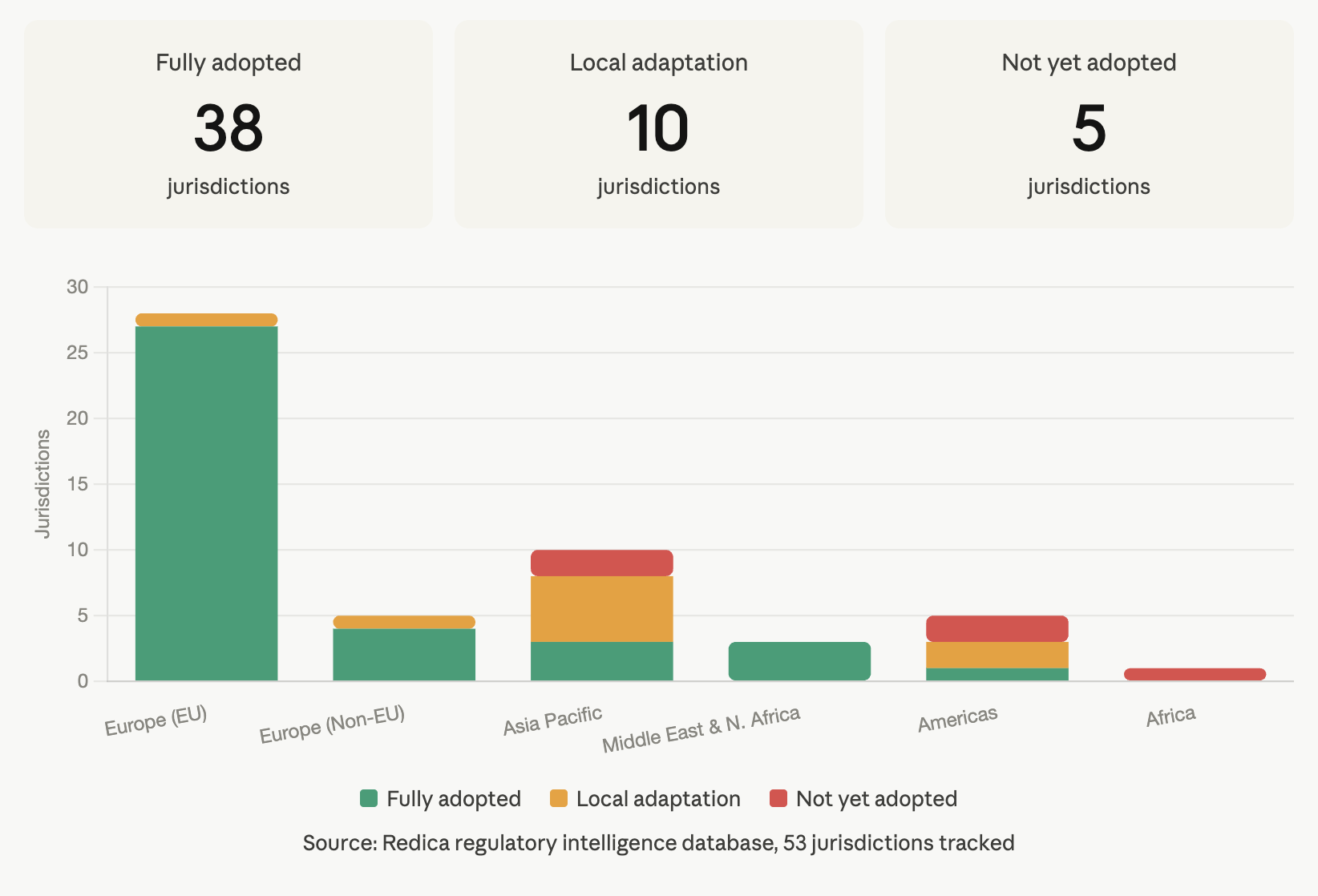
Based on Redica’s analysis of 53 jurisdictions tracked by our platform:
38 countries have formally adopted Annex 1: All 27 EU Member States plus EEA countries (Iceland, Liechtenstein, Norway), the UK, Switzerland, Ukraine, and major markets in Asia Pacific (Singapore, Malaysia, Taiwan) and the Middle East (Israel, Saudi Arabia, Jordan).
10 more have adopted with local adaptations, including Canada, Japan, Australia, South Korea, Indonesia, Hong Kong, Brazil, and France, several with staggered effective dates landing in 2025 and 2026.
Only 5 have not yet formally adopted: Argentina, Mexico, New Zealand, Thailand, and South Africa, most with prospective adoption signaled.
The United States FDA, while not legally bound by Annex 1, actively participated in its drafting and enforces functionally equivalent principles under 21 CFR 211. CCS maps to 211.113/211.100; barrier technologies to 211.63/211.65; APS to 211.113; environmental monitoring to 211.160/211.192.

WHO's adoption of GMP Annex 1 is another demonstration of the Annex's global reach. WHO collaborated with the EU and PIC/S to publish the Annex in 2022 through their technical report, Expert Committee on Specifications for Pharmaceutical Preparations - Fifty-sixth report - WHO TRS N°1044, stating the harmonized text “will benefit the national regulatory authorities and manufacturers and save resources, thus improving patients’ access to quality medicines."
For any global sterile manufacturer, whether biologics, small molecules, combination products, or combination products with devices, Annex 1 governs the expectations of regulators in virtually every market you sell into.
From Guidance to Enforcement: The Gap Nobody Talks About
In recent conversations between Redica CEO Michael de la Torre and a GxP Intelligence Program leader at one of the world's largest pharmaceutical companies, one theme surfaced immediately: the most dangerous compliance gaps aren’t always the ones written in guidance. They emerge when regulators quietly shift their enforcement behavior without changing the text.
“It’s written like this, the guidance didn’t change — but then now you’re telling us something different.”
This is interpretation drift, and it’s especially alive right now with Annex 1. The regulation is new. Inspectors are being trained. Expectations are still forming. The first wave of post-implementation inspections is showing exactly where the regulatory bar actually sits, which isn’t always where the written document suggests.
For global sponsors manufacturing sterile products, this is a critical intelligence problem. Watching how Annex 1 is being enforced across all those jurisdictions simultaneously is not a job for manual monitoring.
The Five Annex 1 Areas Generating the Most Inspection Heat Right Now
The following patterns emerge from Redica's analysis of 483 observations, MHRA inspection reports, and EU enforcement actions—not from FDA data alone.

Redica observation intelligence — sterile manufacturing · 2022–2025



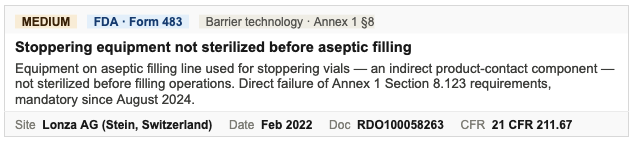
All severity classifications, GMP labeling, and observation summaries based on proprietary Redica Systems methodology.
1. Contamination Control Strategy: From Document to Living System
The CCS was the centerpiece of the revised Annex 1. Most manufacturers built one. The question now is whether inspectors treat it as a document you have, or a system you actively operate.
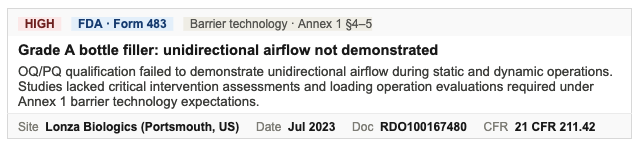
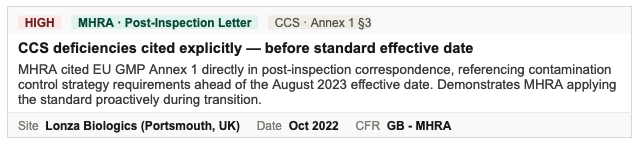
Observations related to 21 CFR 211.113 and 211.42 remained among the most cited for sterile manufacturers in 2024. Non-US regulators are enforcing with equal seriousness: MHRA cited Annex 1 directly in a post-inspection letter to Lonza Biologics in October 2022 - before the standard was effective - and explicitly cited CCS deficiencies in a March 2025 inspection report for FQS Pharma UK. The Lonza network shows FDA, MHRA, and EU regulators each citing sterile manufacturing failures at different sites within the same compliance period.
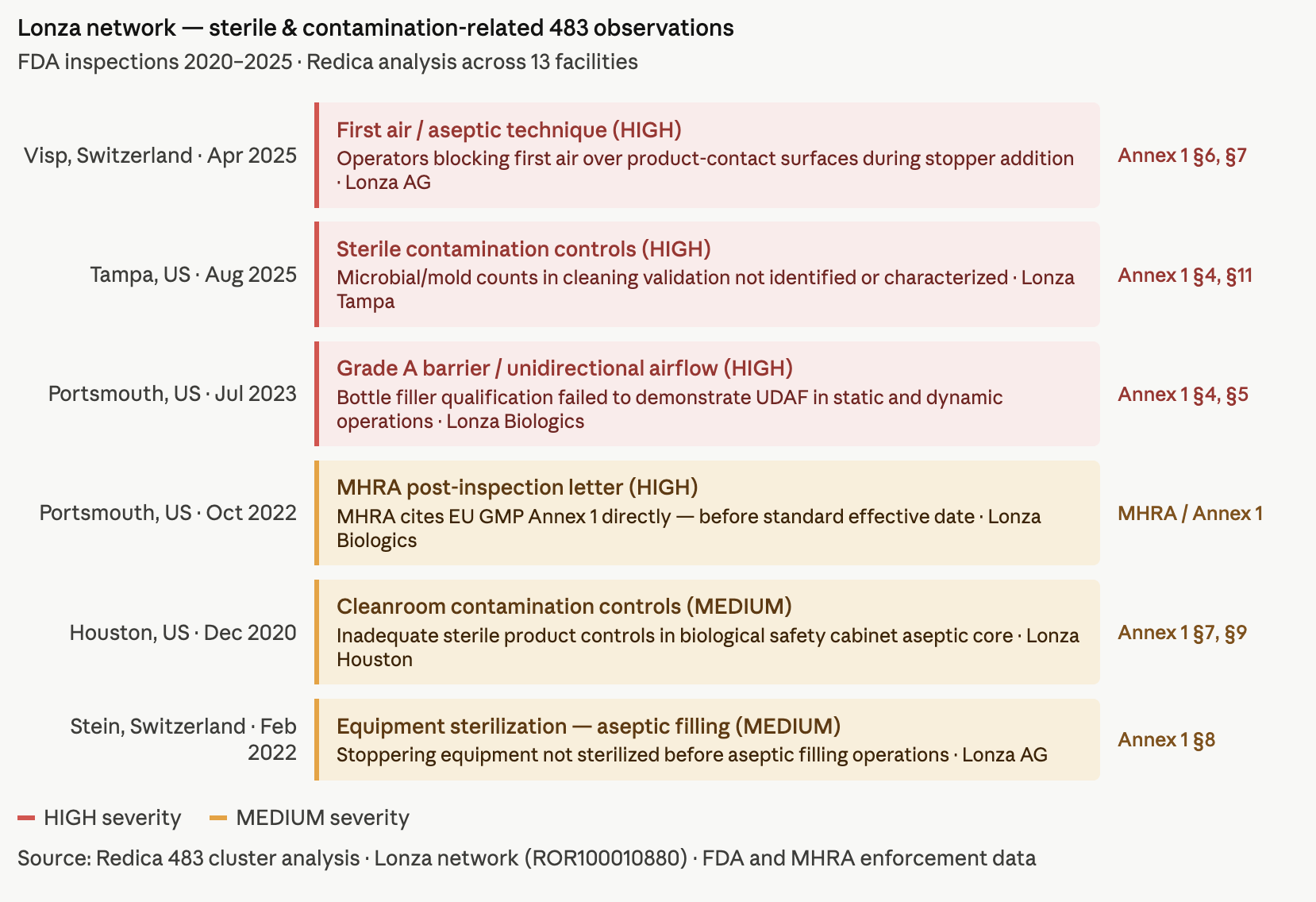
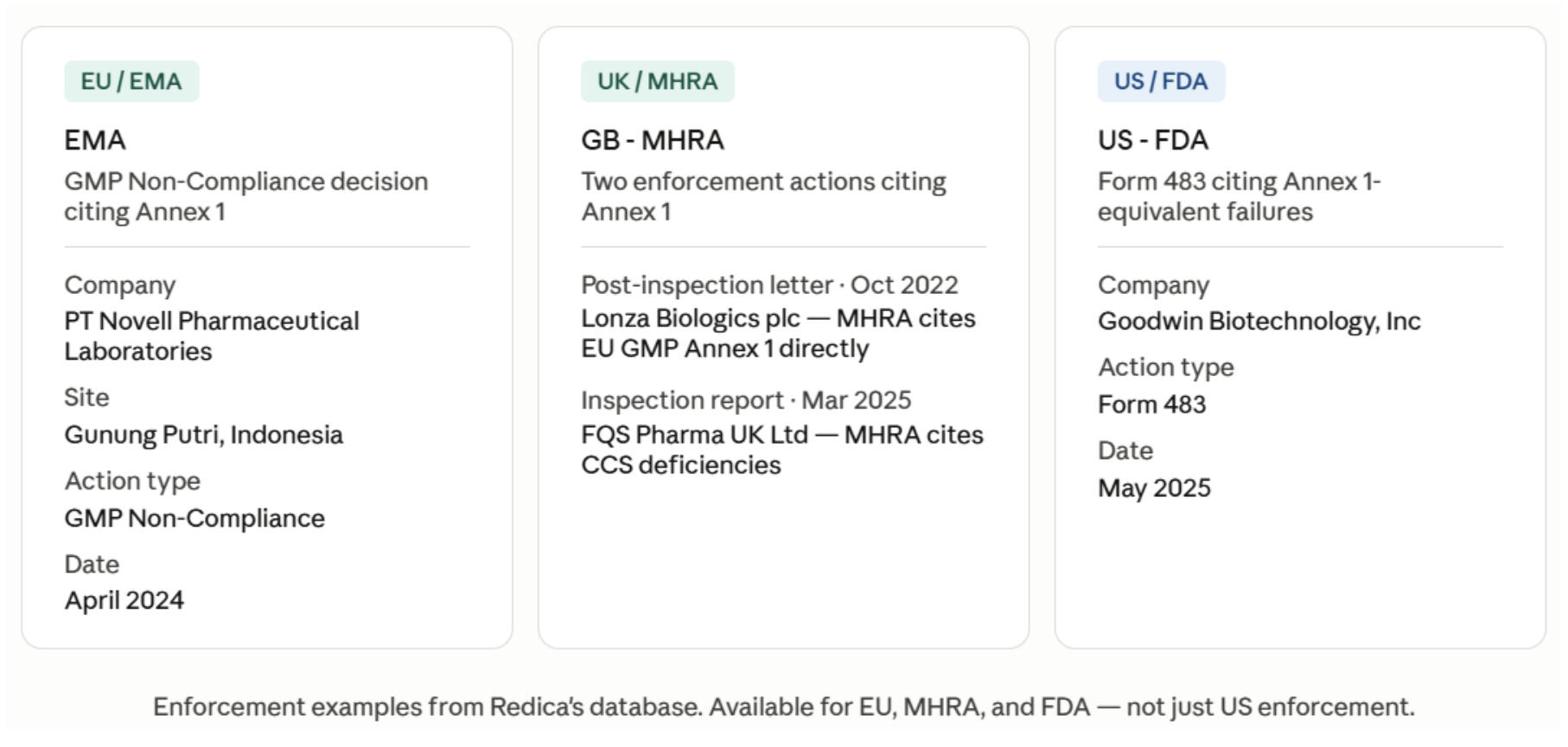
The implication: if your CCS was built as a one-time submission artifact, it will attract scrutiny. Inspectors expect to see it referenced in investigations, CAPAs, and risk assessments… not filed on a shelf.
2. Aseptic Process Simulations: Zero Tolerance Is Real
Under the prior Annex 1, a single contaminated unit triggered investigation and consideration of a repeat. Under the 2022 revision, any contaminated unit means a failed APS — followed by investigation, corrective action, and three consecutive successful runs. Teams that haven’t re-validated their APS acceptance criteria to match this zero-tolerance standard are a clear target. FDA’s active involvement in drafting this tightened requirement means aligned expectations exist on both sides of the Atlantic.
3. Barrier Technologies: Encouraged but Examined
Annex 1 strongly encourages isolators and RABS for new facilities. For existing installations, other approaches can be justified within the CCS, but that justification must be substantive, not generic. The August 2024 deadline for Section 8.123 (lyophilizer sterilization before each batch) has passed, making this a live compliance issue.
Swissmedic’s published Technical Interpretation document explaining exactly how Swiss inspectors will apply the standard is an early signal of where enforcement focus will land. When a regulator publishes its inspector playbook, pay attention.
4. Environmental Monitoring: Continuous Is the Direction of Travel
The revised Annex 1 uses the word “monitoring” five times more frequently than the previous version. Grade A areas now require a zero viable count standard. Regulators are scrutinizing whether EM programs are risk-based and continuous, or intermittent and reactive. Gaps in sampling protocols, weak trend analysis, and failure to act on excursions are showing up in 2024 FDA 483s with regularity, and since Annex 1 and FDA expectations are aligned here, a gap generates citations under either system.
5. Personnel and Gowning: Culture, Not Just Compliance
Annex 1’s emphasis on personnel awareness signals that the drafters viewed human behavior as a primary contamination risk. The Novo Nordisk/former Catalent facility in Indiana received a 483 in mid-2025 for contamination, including extrinsic particles, that was not adequately investigated. At Lonza AG’s Visp site, FDA cited operators blocking first air over product-contact surfaces during stopper addition in April 2025. Same standard, two continents.
Watch the Markets Still Coming Online
For compliance teams managing global supply chains, the multi-jurisdictional adoption timeline is itself an intelligence challenge.
Australia (TGA) began the transition to PIC/S GMP PE 009-17 in September 2025 with full implementation required by March 2026. If your facility manufactures for the Australian market and hasn't mapped your CCS and APS programs against the updated standard, the window is closing.
South Korea (MFDS) set a December 2025 effective date for its Annex 1-aligned regulation, with a published casebook explaining implementation expectations for sterile biopharmaceutical manufacturers.
Japan (PMDA) issued its partial revision in February 2025, formally integrating updated PIC/S GMP guidance including the revised Annex 1 framework.
Indonesia (NADFC) finalized its amendment in March 2025, making PIC/S GMP Annex 1 fully effective in that market.
Canada (Health Canada) adopted its own Annex 1-aligned guidance with an April 2024 effective date, and has since republished it in a more structured format. Redica holds both versions.
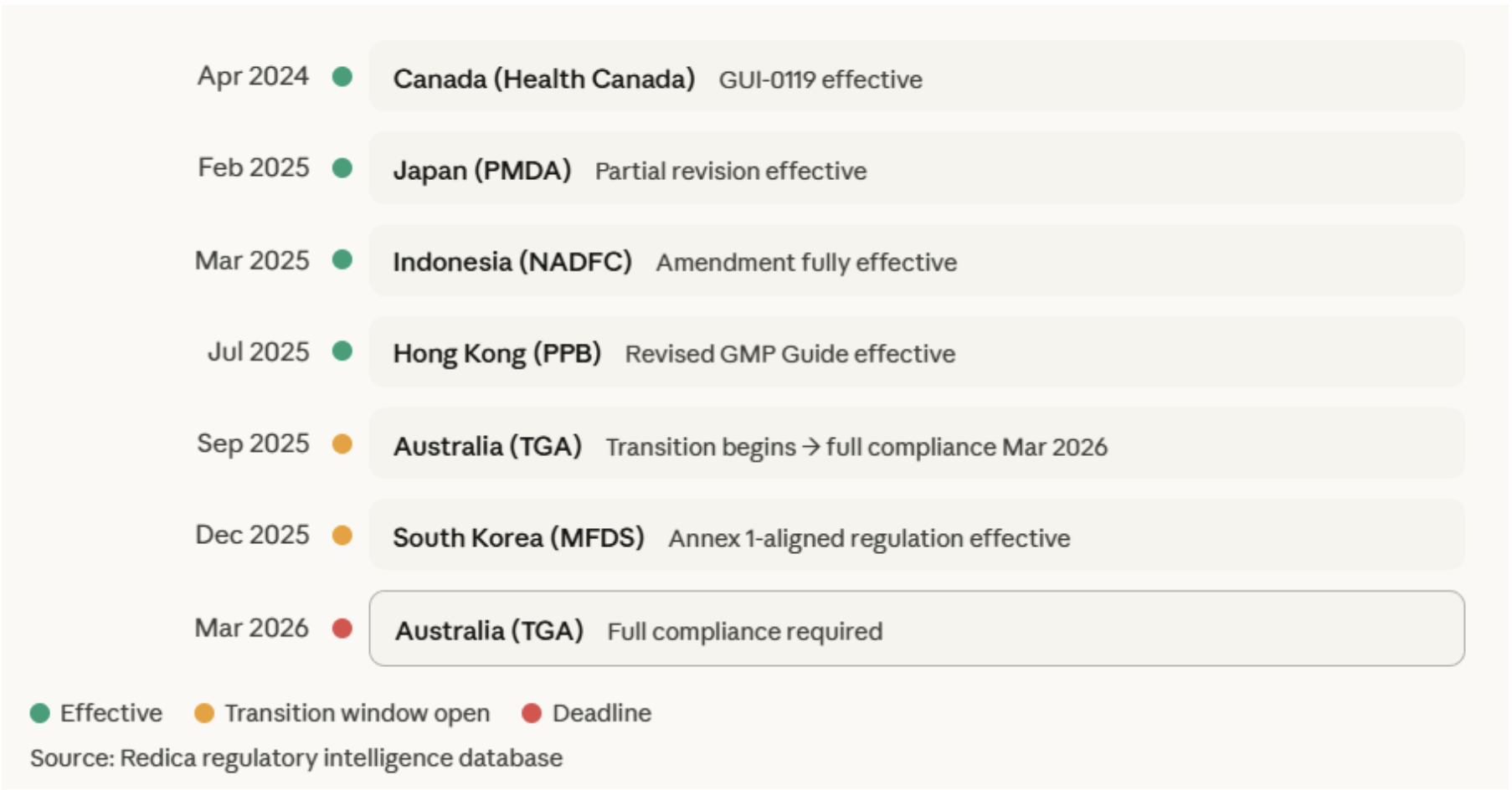
Each of these represents not just a document update, but a signal about where inspector training and enforcement attention will follow.
The Intelligence Challenge: Signals Before They Become Trends
Because Annex 1 is newly effective across so many jurisdictions simultaneously, enforcement patterns are still forming. Some inspectors are applying the standard rigorously; others are still calibrating. The most valuable intelligence isn’t in published guidance; it’s in 483 observations, warning letters, and inspection reports that accumulate before they crystallize into formal messaging.
“We’re trying to understand if there is internal training. Is FDA doing some kind of internal training where they’re training on a specific topic? We’re not aware of that until we start to see it in 483s.”
That’s the signal Redica is designed to surface. Switzerland’s Technical Interpretation and MHRA’s “Common Issues” document for sterile products are examples of regulators making their enforcement thinking visible early—the kind of secondary intelligence that professional compliance teams treat as leading indicators, and that Redica’s platform is purpose-built to track.
What This Means for Your Compliance Program
Know your jurisdictional exposure. If you sell into Europe, the UK, Canada, Singapore, Malaysia, Taiwan, Israel, Saudi Arabia, Jordan, or the US, you are already under Annex 1-equivalent expectations. If you sell into Australia, South Korea, Japan, Hong Kong, or Indonesia, new effective dates are running now.
Benchmark your peers. Observation clusters across product categories and manufacturing technologies — not any single 483 — show where risk is building.
Track inspector behavior, not just regulations. Which inspectors are prioritizing which Annex 1 elements, and is that consistent across regions? That intelligence lets you prepare rather than react.
Monitor for interpretation drift. CCS requirements, APS acceptance criteria, barrier technology justifications all leave room for regulatory judgment. Watching how inspectors apply ambiguous requirements gives a clearer picture than the text alone.
Build early warning into your program. The gap between enforcement emphasis shifting and formal guidance updating can be months or years. A robust intelligence program closes that gap.
How Redica Can Help
Redica holds the reference documents, local adaptations, enforcement records, and inspector profiles across all 53 jurisdictions in this analysis — including every version of Annex 1, every local adaptation, and every complementary guidance document regulators have published about how they will inspect against it.
For Annex 1 specifically, the platform lets you:
- Search globally across regulators: FDA 483 observations, MHRA inspection reports and post-inspection letters, EU GMP non-compliance decisions, and warning letters across sterile manufacturers worldwide, filtered by date, facility type, inspector, or product category.
- Track inspector-level patterns: which Annex 1 elements specific inspectors are emphasizing and how those patterns are evolving across markets.
- Access every local adaptation: Switzerland’s Technical Interpretation, Canada’s GUI-0119, MHRA’s Common Issues document, and EU member state national versions.
- Go beyond agency documents: PDA’s Global Sterile Manufacturing Regulatory Guidance Comparison & Assessment Tool, BioPhorum’s Annex 1 sterile filtration FAQs and drug substance facility guidance, and ISPE’s GPMLF Annex 1 White Paper.
- Monitor emerging markets: track enforcement signals in Australia, South Korea, Japan, and Indonesia before they reach you as a regulatory action.
- Benchmark peers globally: see where similar organizations are being cited across the full international enforcement landscape, not just FDA.
If your team is asking "what is FDA actually expecting on Annex 1 right now?" or "has our APAC contract manufacturer been inspected against the new standard?" those questions are answerable. They just require looking at the right data.
Getting Started
Want to explore how GMP Annex 1 has been adopted across the markets relevant to your supply chain, and see what Annex 1-related enforcement is already showing up in inspections globally?
Request a Demo to See How Redica Can Work for You.
.png)