
Table of contents
The Limits of Regulatory Awareness
Life sciences teams have never suffered from a shortage of regulatory information. On the contrary, the real challenge has always been responding to a published guidance update with a coordinated internal response before the next inspection arrives.
The traditional path runs something like this: A regulatory affairs professional notices an update, manually routes it to subject matter experts via email, waits on responses, documents decisions in a spreadsheet, and hopes the action plan gets completed and recorded before it matters. That model is fragmented, slow, and auditable only in retrospect. The process was never designed for the speed or volume of today's regulatory environment, and there’s a better way forward you need to know about.
What the Integration Actually Does
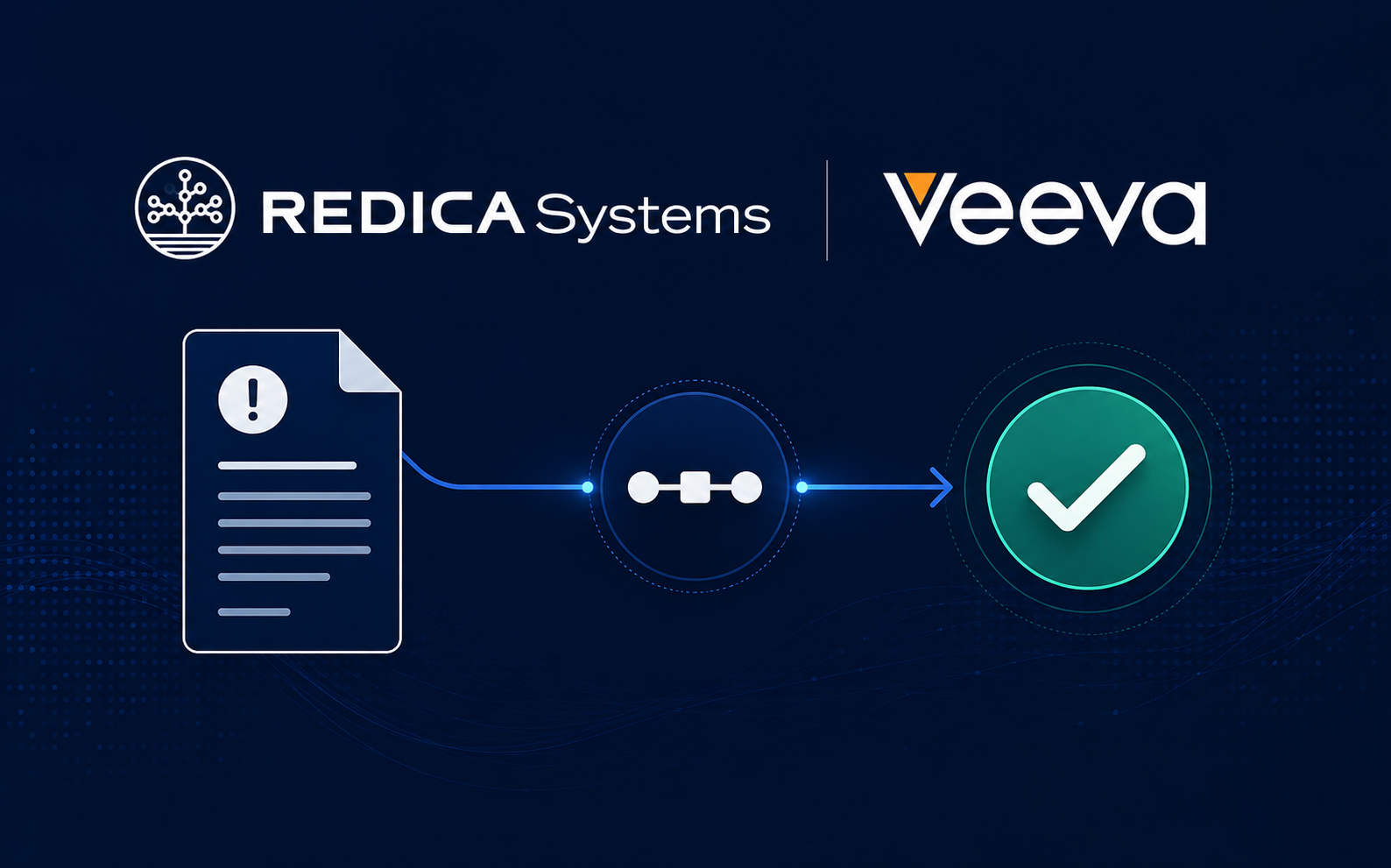
Redica monitors more than 125 global health authorities, standards bodies, and trade associations. When a relevant regulatory document surfaces in Redica's feeds, it’s filtered using Redica labels to identify what applies to a given team's scope. And now, users can initiate an impact assessment directly from that document in Redica and push it to Veeva in a single step.
All of Redica's curated data, including structured metadata, document classification, and AI-generated summaries, is automatically pre-populated into the first step of Veeva's impact assessment workflow. Teams begin from a complete, structured record rather than manually rebuilding context from scratch.
From there, the workflow runs end-to-end inside Veeva across four stages:
- Triage and notification. Impacted divisions are notified with a single click, routed through the workflow rather than an ad hoc email chain. The update reaches the right people because the system determines who is affected.
- Multi-user assessment. The workflow accommodates multiple personas — regulatory affairs leads, quality managers, subject matter experts — each assigned specific tasks at different stages of the assessment lifecycle. A guidance document can be triaged to multiple SMEs simultaneously, with each evaluating impact from their area of responsibility.
- Action plan documentation. Once impact is assessed and an action plan is approved, the tasks required to confirm compliance are assigned, completed, and documented within the same workflow. The record that began with the regulatory document carries through to resolution without being handed off to another system.
- Final verification and closure. Before an assessment is closed, a final verification step confirms that all action items have been completed and compliance with the original regulatory guidance has been established. The closed assessment is then stored in Veeva's library, linked directly to the regulatory guidance document that triggered it, and available for future reference.
Why the Workflow Architecture Matters for Inspection Readiness
The end-to-end structure of this integration produces something that fragmented processes simply cannot manage: a complete, auditable record that connects a regulatory signal to a verified compliance outcome.
When an inspector asks whether a team was aware of a specific guidance update and what they did about it, the answer no longer has to be cobbled together from email threads and institutional memory. It lives in a closed impact assessment, linked to the source document, with a documented action plan and a verified completion record. When the workflow makes documentation the natural path forward, documentation happens consistently.
This matters just as much for MedTech teams navigating evolving EU MDR/IVDR obligations and FDA guidance updates. The same inspection-readiness challenge of proving awareness and documented response to regulatory change that plagues pharmaceutical quality teams is just as present in medical device environments, where the gap between a published guidance update and an auditable compliance record can directly affect product approval timelines.
The Data Infrastructure Behind the Integration
The pre-population of Redica's curated data into Veeva's workflow is what makes the integration viable. Redica has spent years building the structure that enables this, including a deep regulatory taxonomy, universal Redica IDs, a proprietary knowledge graph, and a human curation layer that converts unstructured regulatory output into something a downstream workflow can act on.
AI-generated summaries can accelerate the assessment process, but those summaries are only useful because the underlying data is already classified, linked, and verified by Redica's intelligence layer before it ever reaches the workflow. Structure is what converts AI output into actionable insights. Without that foundation, teams will still need to do manual triage regardless of what tools sit on top.
How This Fits the Broader Strategy
As we explored in our conversation with Redica CEO Michael de la Torre and SVP of Regulatory Intelligence Scott Sherrill on the Veeva Training Solutions partnership, keeping training content current as regulations evolve is one dimension of this challenge. The Veeva RIM integration focuses on what teams do in response to a change once it's identified. Together, they represent two distinct phases of the same compliance lifecycle, both now connected to Redica's intelligence layer.
The inspection question that regulatory and quality teams dread most is rarely about awareness. Inspectors want to know what a team did in response to a guidance update, when they did it, and whether there is a documented record to prove it. This integration is designed to answer that question not at the moment it's asked, but long before it ever comes up. For MedTech organizations in particular, where regulatory scrutiny spans device design, manufacturing controls, and post-market surveillance, having that auditable thread from regulatory signal to resolved action is a massive competitive advantage.
Learn more about how Redica intelligence works inside the platforms your team already relies on.
